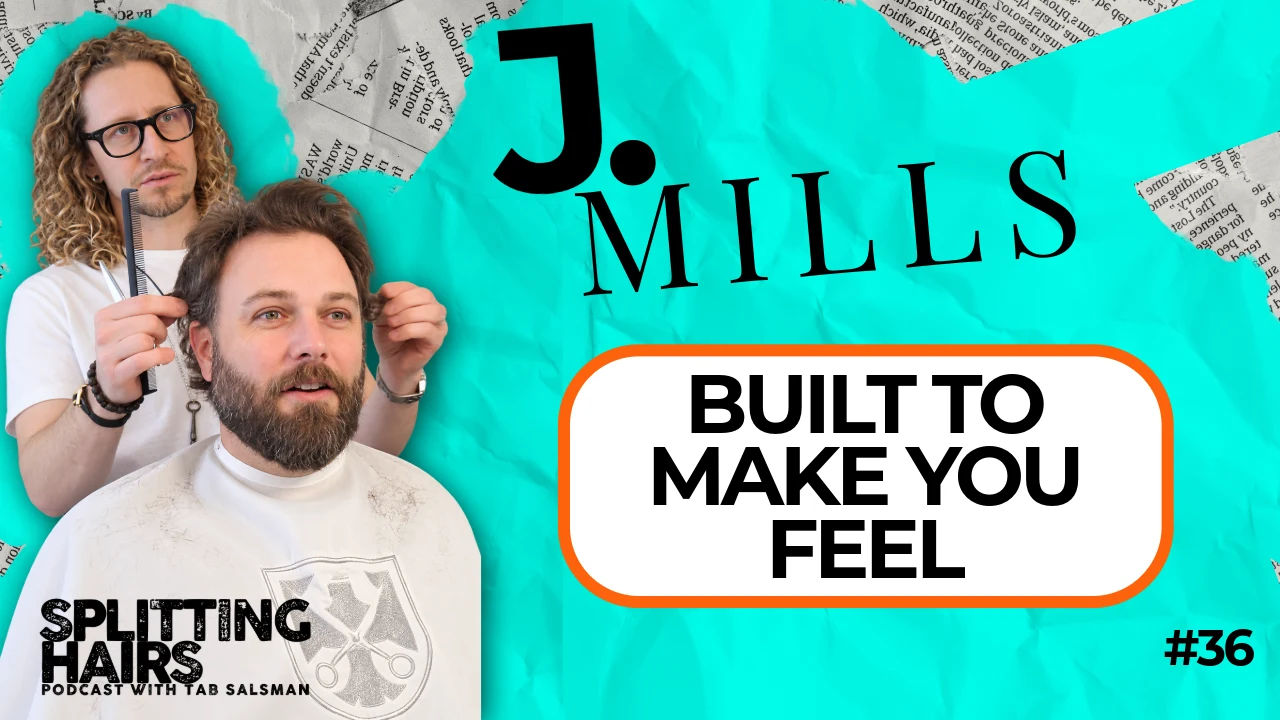
Bill Schultz turned down law school, got in a car with his girlfriend—now his wife—and moved to Los Angeles in 1982. There was no backup plan. He was going to make a life in entertainment, even if the route changed along the way.
That willingness to course-correct took him from chasing work as a songwriter and screenwriter to discovering the role that fit him best: producer. A job in Capitol Records' royalty department led to production-assistant work, and a sudden opening on a low-budget film taught him a lesson that kept paying off—sometimes the way forward is simply to say yes, then learn how to do the job.
While Tab cuts his hair, the four-time Emmy-winning producer explains what a producer actually does, why the best ones tend to be control freaks, and how seeing every dollar and every department on a production helped him understand the entire machine.
“There was no plan B. I was going to make this work. It was going to happen.”
From there, the conversation moves through the shows and characters that shaped a generation. Bill talks about helping build Bobby's World around Howie Mandel's unmistakable creative voice, supporting the artists behind The Simpsons, and protecting what makes a creator's idea feel authentic when it passes through a studio.
His career also reaches into G.I. Joe, Transformers, and Muppet Babies—three personal favorites of Tab's—along with Garfield & Friends, King of the Hill, Ed, Edd n Eddy, Clifford the Big Red Dog, and decades of creator-driven animation.
Bill and Tab get into persistence, creative ownership, the difference between manufacturing content and staying true to its source, and why audiences can sense when the people making something genuinely believe in it.
When there is no backup plan, how do you keep moving without losing sight of what you wanted in the first place?
Bill kept saying yes to the next opportunity without abandoning the larger direction. Those choices eventually turned an ambition to work in entertainment into a career spent building stories for millions of people.
In their own words
Read the conversation
Follow along with Tab Salsman and Bill Schultz as they talk about storytelling, creative careers, and building a life in entertainment.
Show full transcript
Transcribed from the source recording. Timestamps may differ from the edited video.
Tab Salsman
Thank you so much, Bill. I really appreciate you taking time out of your day for coming over here and shooting the shit with me and talking about what it is that you do, who you are. Um, we've already talked about your haircut off-camera- Yeah ... so I know what we're gonna be doing there. So Bill, you are a producer.
Tab Salsman
You're Emmy Award-winning. My question is: how did you ... What made you wanna become a producer? And, like, what's a producer?
Bill Schultz
That's a good question. Uh, that ... It is a, it is a good question, actually, because, you know, producer is a widely used term to describe many, many different circumstances of work. Um, so you know, you have to really look at the specific industry.
Bill Schultz
Okay. And when I say industry, uh, to me, uh, television production, soap operas, let's say- Yeah ... is different than primetime one-hour dramas, uh, which is different from, uh, morning television, um, which is different from the news. So every industry and every genre of content The term producer is a little bit different.
Bill Schultz
So for me, the way I, I started to think about becoming a producer was, uh, when I graduated University of Illinois Champaign-Urbana, um, I decided I wanted to be a songwriter and a screenwriter, um, because I had always been in bands playing music growing up, and I also, um, uh, you know, would write stories and we would film little dramas, and in school I, you know, did some short films.
Bill Schultz
Um, but I never considered it seriously. And I- instead of going to law school back at University of Pennsylvania where I was accepted, I decided to just get in the car with my, my girlfriend, who's now my wife, uh, and, uh, 1982, and we moved to Los Angeles, and I started trying to find my way into the entertainment business as a, as a songwriter and as a screenwriter.
Bill Schultz
And then, um, after I started... Uh, first job I actually got was working at Capitol Records. Believe it or not, it was, uh, in the royalty department, you know, and I would see, like, these royalty statements for, like, Kenny Rogers for, like, $6.7 million, or The Beatles, and I was like, "Ugh." You know, meanwhile, I was think- I was earning about $1,100 a month.
Bill Schultz
Um, but, uh, I didn't really wanna be in the royalty department at, at, uh... But it, it was, it was good to just see, uh, an aspect of the industry. But then I got a job working as a PA for this producer who said he would pay me when he could.
Tab Salsman
Real quick, what's a PA mean?
Bill Schultz
Production assistant. Thank you. Yeah. Um, and, uh, and again, the, another broad term.
Bill Schultz
But anyhow, I went from there and I got other jobs as a PA on movies, uh- Mm-hmm ... some, you know, uh, uh, let's say B movies or whatever.
Tab Salsman
Yeah.
Bill Schultz
One called Down On Us, which was, uh, uh, this guy who was a, uh, a director, uh, of, like, um, l- real low budget stuff. Wow. He did it all on the sound stage down in downtown LA, and, uh, he, um, he needed help.
Bill Schultz
Um, you know, uh... Well, actually, let me say this again. I was hired as a PA- Yeah ... for, like, $300 a week on this movie, Down On Us, and, uh, I was, um, standing there when somebody came into the office and said to the guy- The, the EP that he had as partners, and I forgot his name, it was Murray, um, had a heart attack.
Bill Schultz
He was gonna live, but they needed someone who could do the payroll. And so I said, "Oh, I, I know how to... I can do that."
Tab Salsman
From the royalties?
Bill Schultz
No. Oh. I was totally... So I learned you always just say yes. Um, but I, you know, I mean, how hard could it be? So there were no computers then, so think about it. It was like I literally took a book, the little booklet- Yeah
Bill Schultz
from the IRS and just did it, and it was all by, you know, hand. Wow. So I was always good with math. And, um, so anyhow, yeah, I, it basically opened up the entire world of the production of this movie. I got to see where every penny went. I got to understand who did what, you know, from the electric department to the-
Tab Salsman
Yeah
Bill Schultz
the grip department, whatever it was. Um, and, uh, so I was like, okay, so if I wanna m- And, and I ended up saying to myself, "Well, if I wanna produce, if I wanna m- be a screenwriter, I'd rather be a producer because I can control the whole process." I am a bit of a control freak. So I would say one thing a producer is- Yeah
Bill Schultz
is probably a control freak. Producers like, you know, if you ever walked into a Starbucks and you, like, don't like the way the line is being, uh, executed, like, "Oh, they should have another person over there doing..." You're probably a producer and you just don't know it yet. You always want, when you think you can rearrange a situation, make it more efficient, make it better, that's what really being a producer is.
Bill Schultz
And so, uh, for me, I, um, I worked on things like, uh, M- Mickey Spillane's Mike Hammer for Columbia Pictures, and Crazy Like a Fox, and, uh, T.J. Hooker. Mm-hmm. Um, worked on the, the TBS lot, driving a golf cart around and- ... you know, learning everything I could, of course. And, um, that made me really want to become a producer.
Bill Schultz
And so I, uh, I kind of took a, a little bit of a, a 20-degree turn, um, and because there are producers who, writers in, in a lot of industries are producers. Yeah. Um, and, uh, so it's, the two are very related. Um, wanna take a drink of water here.
Tab Salsman
Yeah.
Bill Schultz
Uh, 'cause I think I'm taking too long. This is me off, but I'm taking too long to get to the-
Tab Salsman
Oh, no, I love these stories. Oh,
Bill Schultz
you're okay.
Tab Salsman
I love all, I love all that. I, that, I rather you be talking, telling the details, 'cause I, I'm so long-winded. I love hearing all those little things. Because the things that I heard from that is like, you know, you moved to LA, and it sounded like you had a plan B, like you could always go back to Pennsylvania and go to law.
Bill Schultz
I, you know, I never considered that.
Tab Salsman
So that, so that was my next question.
Bill Schultz
Yeah.
Tab Salsman
Is I've, uh, something I've talked to with different people is that when they end up pursuing the thing that they set out to pursue, you ask them, "What was your backup plan?"
Bill Schultz
Right.
Tab Salsman
And you know what they say?
Bill Schultz
You
Tab Salsman
know what? "I never thought about it."
Tab Salsman
It,
Bill Schultz
it's amazing that you bring that up, because until just this moment now-
Tab Salsman
Yeah ...
Bill Schultz
I always heard that too, and I always thought that was so amazing how, how convicted those people were- Yeah ... and what they were. And I never thought that that applied to me. But when you just asked me, "What was my plan B?" And I said, "I didn't have one," that is the God's honest truth.
Bill Schultz
There was no plan B. I was going to make this work. It was gonna happen, and I didn't care. You know, the thing I would say I did was I was willing to course correct. So when I realized that becoming a writer was gonna be a longer path, and I also really liked pr- the idea of I liked what producers did, I said to myself, "Well, that's okay."
Bill Schultz
So that, I got one step closer to doing something that I could do with passion. And so, yeah, that is ... It's, I, I don't think that it was the, the idea of not having a plan B. It's just that I don't want a plan B. This is what I wanna do, and I am totally convinced that this is what I will do.
Tab Salsman
Yeah, and course correcting to me is very different than having a predetermined backup plan.
Bill Schultz
Yeah.
Tab Salsman
Like, people are like- Totally ... "Hey, if I don't make this, I can always run the family business." Right, right. "If this doesn't work out, I have a house I can move back to with my parents," right?
Bill Schultz
I definitely did not have that. And the funny thing is, is that, and I feel bad that I said this my, you know, it was a long time ago, six, 50 years ago, when I was a teenager and I worked for my dad at the, his, uh, bath shop.
Bill Schultz
Mm-hmm. He was, he owned a couple of bath shops in, in Chicago. Um, and I said, "I'm really glad I got to work for you this summer, 'cause now I know what I don't wanna do."
Tab Salsman
Yeah.
Bill Schultz
Retail. I couldn't stand retail. But,
Tab Salsman
but knowing what you don't wanna do- Yes ... is just as valuable.
Bill Schultz
That's, it is. It is.
Tab Salsman
Like, my dad is a electrician by trade.
Bill Schultz
Okay.
Tab Salsman
And thank God I know how to do some electrical stuff- Sure ... because he's, like, taught me, like, "Hey- But that's very
Bill Schultz
practical ...
Tab Salsman
hey, here's how you change a fuse. Here's how you don't, you know, blow your face off with stuff." Right,
Bill Schultz
right.
Tab Salsman
You know, it's, I can sa- I- That's
Bill Schultz
valuable.
Tab Salsman
Yeah, absolutely. And it helped me when my dad and I rebuilt my muscle car.
Tab Salsman
Yeah, yeah, yeah. Like, I know how to rewire a car, right? Sure. Very useful things. Um- But at the same time, I also know I didn't wanna do that sort of work. I didn't wanna be in that labor department. I did not want to do that. So I wanted to figure out, well, how can I do the things that I wanna do and knowing what I don't want?
Bill Schultz
Yeah. Yeah.
Tab Salsman
I never did electric work. I just saw it and go, "I don't think that's for me."
Bill Schultz
Yeah.
Tab Salsman
You know, I see people who-
Bill Schultz
You have to get out there and experience things- Yeah ... to know it's... I guess the point is it's really as important to know what you don't wanna do as knowing what you do wanna do. And if you don't know what you wanna do, then just try anything and see what you don't wanna do.
Bill Schultz
Because as I sit here now, I realize that that really shaped... 'Cause I loved music. You know, like- Yeah ... I, music to me was like, playing music, you know, was like, that was the f- that was like a treat. And in, in my family, uh, my uncle had perfect pitch, and he... Really strange thing, this is back in probably n- New York in the 1950s, uh, or '40s maybe.
Bill Schultz
He got an offer to be trained under This conductor named Andre Kostelanetz, you can look it up on Google. Anyhow, he was only five years old. He was a prodigy. My grandmother said, "No, you're not gonna mess him up." So she didn't let him do it. He became a podiatrist. Wow. So, you know, the, the point is in a lot of middle class- Yeah
Bill Schultz
Jewish families, you don't become a musician or a, a writer or s- you know, you become a doctor- A lawyer ... a lawyer or, right, or an accountant. So when I, when I realized I didn't have to follow that path, and I could, I could play music, and I could make films- Mm-hmm ... and that would be my work. Yeah. And so I will tell you this, for my entire f- 40-year career, I never once went into the office saying, "Ugh, God, here I go again."
Bill Schultz
Yeah. Another... You know, as if I had taken a job as an insurance salesman. Mm-hmm. And if you love selling insurance, no, great. Yeah. Whatever you love doing- Yeah ... that's creative. It is. It's true. Anything that you're passionate about, anything that gets you into that flow state, that's creative. I, I really do believe that.
Bill Schultz
So, so for me, if you trace my path, I, um, s- my f- uh, first job, let, let's... I was a PA on these movies- Yeah ... and I learned about producing films, you know, low-budget films, which... Down and dirty. Then I got a job at Columbia Pictures Television working on these primetime shows. Yeah. Like, you know- T.J. Hooker? T.J.
Bill Schultz
Hooker. I mean, who doesn't know T.J. Hooker? Yeah. And, you know, going around the set and, and looking at, getting to understand the whole wardrobe department, the whole, um, lighting, the whole sound, the post-production, all of this, makeup departments, transportation, everything. Learning, and I learned how budgets are put together, how finance happens, and then I got hired by a company that, um, they hired me as a, like, a production accountant, um, for a show called Santa Barbara, the soap opera.
Tab Salsman
I don't, I never-
Bill Schultz
Yeah. Santa Barbara- It was on NBC for- S- soap
Tab Salsman
operas- ...
Bill Schultz
several years ...
Tab Salsman
were, were never my, my, my thing It
Bill Schultz
was a, it was an amazing... 'Cause that's 260 hours of television a year.
Tab Salsman
It's insane. I had a client, Steve B- Burton, who is on General Hospital forever. Okay. And being his hairdresser for that time when I, before I moved to Texas, he would come in every week and a half, if not two weeks, to maintain the same haircut.
Bill Schultz
Right.
Tab Salsman
So there c- Oh, right ... there had to be so much- Continuity ... continuity. Yeah. And then every now and then he'd come in with, like, a scraggly beard or something, and I'm like, "What happened?" He's like, "Well, my character's not on the show for a while." I'm like, "Why?" He's like, "Well, I'll find out. If I got killed or, mysteriously in a car wreck or something."
Tab Salsman
Yeah. And, um, so he's like, "Right now I can play around with stuff." But soon enough, he'd be, "Hey, we have to go back to this." And he'd, he would show me the photo like, "This is where they left off. We have to look the same."
Bill Schultz
Well, you know who, who was on, um, Santa Barbara? There were a lot of very famous people, but, uh, the one that was really funny was, uh, Robin Wright.
Bill Schultz
You know, she was- Yeah ... in House of Cards, Robin Wright. She
Tab Salsman
was, she married Sean Penn,
Bill Schultz
right? So she, right. Yep.
Tab Salsman
Yeah.
Bill Schultz
Huge celebrity, but when she came on-
Tab Salsman
And Jenny in-
Bill Schultz
Yes In, in- In, uh, life- Forest Gump ... is a box of chocolates, yeah. Yeah. So she worked on... She was a young ingenue on Santa Barbara. Oh. So she would come into the office every day.
Bill Schultz
She had a Shar Pei dog. Mm-hmm. And every week she would come in, and the dog would have something else missing, 'cause they're very, you know, inbred dogs. But she- A lot of
Tab Salsman
skin issues.
Bill Schultz
Yeah, exactly. So she was, uh, she was on the show for, you know, probably more than a year or so. Um, but it was just an amazing...
Bill Schultz
The thing, the... What, what I learned on, on Santa Barbara was that the creators of the show, the Dobsons, her mother, Bridget Dobson's mother created, I think, General Hospital. Oh. Or All My... Yeah, General Hospital. Um, so they, she had this successful soap opera, but she and her husband were not good producers.
Bill Schultz
They wrote the show into the ground. They said, "Oh, let's do a, let's go on location in Italy." Well, they didn't have the budget for that, but they did it. Mm-hmm. And so basically they went bankrupt. And so this company called New World Entertainment, which was the company that hired me, bought the show and became the owner of it.
Bill Schultz
And, uh, like John Feltheimer was the creative executive. He's now the CEO of Lionsgate.
Tab Salsman
Yeah.
Bill Schultz
Um- I
Tab Salsman
remember seeing New World Entertainment.
Bill Schultz
Yeah. You've se- yeah, definitely. I, I- It, it was a very big company ... I'm
Tab Salsman
trying to think who, what other things are under that.
Bill Schultz
Oh, they owned, they owned Marvel. So while I was work- I worked for two years on Santa Barbara with the, on the pro- as a production controller.
Bill Schultz
That's what my title was. Um, and then, uh, New World bought Marvel Animation.
Tab Salsman
Mm.
Bill Schultz
So the executive at New World, a guy named Jerry Ahearn, um, who s- saw what I did on Santa Barbara, he said, "I, I really like what you've done, and I want... We're gonna... We've just bought an animation studio. I'd like you to go over there for me and work with me as we're gonna do a turnaround."
Bill Schultz
Because similarly to the Santa Barbara show, the Marvel owners, uh, it, it was a publishing company out of New York, um, and they, uh, Cadence, I think, is what it was called. They, they, the production got out of control. They were so successful. They were producing all the stuff for Hasbro, My Little Pony, Transformers, G.I.
Bill Schultz
Joe. Um, and we were, they were also doing Muppet Babies for Jim Henson with CBS, Emmy award-winning show. And so I go- so I went over there, and I basically got a two-year, three-year education on animation. In fact, I made... And because I always had a desire to tell stories and be involved in the development and production-
Tab Salsman
Yeah
Bill Schultz
I think two things that were significant there for me was, one, um, the president of the company, a woman named Margaret Loesch, saw that I was this, you know, young, energetic, uh, creative guy, and she made me the director of development. And gave me a chance to, you know, help develop all the new shows. Um, and so there I got, you know, pitch...
Bill Schultz
We'd go to the network pitches and do all that. I even actually... So the second thing is I created a show called Battle of the Bands. It was a live action show, 'cause they were gonna be replacing American Bandstand. Mm.
Tab Salsman
Mm-hmm.
Bill Schultz
And so they were looking for another show that could go in there. So my idea was Battle of the Bands, and I had one of the animation artists draw the set, and my set was three judges in three chairs sitting across from the stage- and the band performing on the stage and doing the up close. Uh, of course it's now American Idol. Or
Tab Salsman
America's Got Talent.
Bill Schultz
Yeah, all of them. So I did that in 1986 maybe. Wow. And I got a co- You can s- go to copyright office, Battle of the Bands, Bill SChultz and I, I brought my, uh, school f- friend Steve McKeever in on it.
Bill Schultz
He went to Harvard Law School and then came out to be a, a Hollywood executive. But yeah, we, uh, we sold the concept. We did a whole trailer and we d- It didn't sell though. But it was... But now here I am. So I picked up those skills. And so from there I was hired by the guy who ran, who own- Phil Roman. Film Roman.
Bill Schultz
And he was just starting to produce a series of Garfield for CBS Saturday Morning. He had produced the Garfield primetime special, The Garfield Christmas. Mm-hmm. Uh, we were just finishing up Babes and Bullets. But to do a series- Yeah ... he needed someone with experience. So I came in and I basically organized everything and w- as the h- the vice president of production and development.
Bill Schultz
And, uh, I, I don't wanna say the rest is history, but the, the, the rest is. So that was in... You know, I, I stayed at Film Roman. We grew to, like, 500 people. We produced The Simpsons, King of the Hill. Garfield, uh, Mighty Max, uh Oh, you know, I could go on for a little while. Um, um, The Critic, one of my favorite shows.
Bill Schultz
Oh, I
Tab Salsman
mean-
Bill Schultz
Yeah ...
Tab Salsman
I mean.
Bill Schultz
That was Jim Brooks also. Uh, so we, you know. And that was great because, you know, we were doing something right, because here, you know, they brought The Simpsons to us because we were known as a boutique studio, but had the ability to produce at scale.
Tab Salsman
Yeah.
Bill Schultz
So The Simpsons, you know, it was 130-person crew because so much of the work was done in, in LA as opposed to just overseas, let's say, like Saturday morning shows are done.
Bill Schultz
Um, and there were no computers to start.
Tab Salsman
Oh, I, I tried to explain this to my kids- ... when we're watching like a Disney cartoon or whatever. I'm like, "This was all done by hand." And they don't understand what by hand means.
Bill Schultz
Mm-hmm.
Tab Salsman
So I'm now going to have to go to YouTube and have to find these videos of how they did animation, because animation is so different, uh, from when I grew up-
Bill Schultz
Yeah
Tab Salsman
to what they're doing now. Yeah, it is. And I mean, your career is, to me, proof of what I believe when someone says they're lucky. Yeah. And luck, to me, is where hard work meets opportunity.
Bill Schultz
Yeah.
Tab Salsman
Because had you not done the hard work-
Bill Schultz
Yeah ...
Tab Salsman
it would have not led you to the opportunity. And there's so many times in life we are given opportunities, but th- those, we're not, we don't have the skill set to take the opportunity.
Tab Salsman
And we know that. We go, "Oh, I don't know if I wanna take that job because I haven't done something enough." Yeah,
Bill Schultz
fear. You know? Fear. Well, you know, fear of the unknown is the re- S- You know, so I, I frequently get calls and, or references from people-
Tab Salsman
Yeah ...
Bill Schultz
who either, uh, you know, it's their, it's their grandson or it's their nephew or whatever it is.
Bill Schultz
But young people who are, you know, just about to get out of school, and they wanna be in this business, but they don't know what to do.
Tab Salsman
It's confusing.
Bill Schultz
And, yeah, it is, because there is no-
Tab Salsman
Direct path ...
Bill Schultz
you know? Yeah. There's no it's, it's not like becoming a CPA and you, okay, take the-
Tab Salsman
I
Bill Schultz
mean- ... the test ...
Tab Salsman
your, your earlier observation about growing up, you know, it's like your family was like, "Hey, doctor, lawyer-" Yeah,
Bill Schultz
yeah
Bill Schultz
"accountant." It's a ca- that's a, that's a profession.
Tab Salsman
It's also a direct career path.
Bill Schultz
Yes.
Tab Salsman
You know, if you do- Yes ... enough of these things- You're right ... you're going to get to the end. That's right. There's no school-
Bill Schultz
No, there's no guarantees ... for
Tab Salsman
entertainment.
Bill Schultz
You're right. I mean- So what I, what I say to people- Yeah
Bill Schultz
'cause I don't wanna discourage anyone. Yeah. Because if probably I would've faced discouragement from a lot of people, maybe I would, maybe I would've been like, "I can't do this." But my experience was if you're willing to do it and you're passionate about it, and, and you believe in yourself- You will make it.
Bill Schultz
You'll, I don't know how you will make it, or I can't tell you exactly what to do or what not to do, but, uh, what I know is that the, the, the entertainment industry is always looking for young, uh, energetic, authentic, you know, people to come in and whether it's to become... I have friends who went into the agency programs.
Bill Schultz
Yeah. Um, I, you know, friends who s- as were writers or, you know, whatever it is. Um, but if you're talented and you work hard, you, you can succeed. You really can, and it's hard. I'm not saying you're not gonna have to pay dues. Definitely. Oh. I mean, I, I, I paid my dues. I could not- I bet you did ... I couldn't even afford to pay a $15 a month Wickes furniture bill, bill.
Bill Schultz
My wife and I bought a waterbed at Wickes. And it was, uh, we were late, like, three times on a $15 a month bill, you know? Yeah. And it, that followed me around. But, you know, it's, um, but like, you know, I guess the gift is that I ne- I didn't regr- have regrets.
Tab Salsman
That's good.
Bill Schultz
That's, that's I think important.
Tab Salsman
Well, I'm gonna have regrets if I don't put this cape on you and give you a haircut.
Bill Schultz
Yeah, exactly. Let's go. Let's get some, uh... I, I...
Tab Salsman
All right. Here we go.
Bill Schultz
All right. So- The moment of truth. All right, I'm gonna take this side. Dun, dun, dun.
Tab Salsman
Is that too tight? Yeah.
Bill Schultz
No, it's good. It's good
Tab Salsman
Okay, make sure that, um, I might do
Bill Schultz
this- So do you put any of, any of the discussion of the hair in the thing?
Tab Salsman
No, I used to. No? I used to just kind of- Okay ... bog it down. That was the thing that I,
Bill Schultz
I learned But, you know, the only thing is I would say about that is when I heard, uh, Barry tell me that you did podcasts while you were cutting people's hair, I thought that that was a really clever hook.
Bill Schultz
Like, it was a really nice concept.
Tab Salsman
Thank you ...
Bill Schultz
a g- because a haircut has a structure. So l- let's take the haircut as let's c- let's, let's develop the haircut as a TV show, right? Yeah. It has a s- it has a beginning, middle, and an end. Yeah. So it has the structure, and so for me as a storyteller, that's what I always look for.
Bill Schultz
I look at situations and there are some situations where it's just, it's a really interesting moment, but if you don't know where the beginning is and you don't know where the m- end is, then you're not gonna know where the middle is. Yeah. And then, you know, when they talk about the, the traditional Hollywood- Three-part act?
Bill Schultz
structure, yeah. In, in, uh, Joseph Campbell's, um, The Hero's Journey. Mm-hmm. It's a great, if you ever can look up The Hero-
Tab Salsman
Oh, yeah, that's Star Wars ...
Bill Schultz
that's, yeah. It's the key to all good storytelling, I think. Yeah. Like, I, I felt like I at one point could just take any situation and apply that to it. Mm-hmm. And that would make a good story.
Bill Schultz
But the haircut, so it naturally to me is like the beginning- Beginning, middle, end ... middle, and end. Now, w- what if, you know, you, you start to apply, um- You know, different creative, uh, elements to the haircut, you know, to give it a little twist. Oh. Like you say the, uh, the haircutter is really a scientist who's taking the DNA from the hair of the people he cuts.
Bill Schultz
I don't know. You
Tab Salsman
know what's funny? I actually have always said if Law & Order ever needed, uh, a r- if, if they ever ran out of ideas-
Bill Schultz
Yeah ... it
Tab Salsman
would just be a high-profile hairdresser-
Bill Schultz
Yeah ...
Tab Salsman
is found dead-
Bill Schultz
Yeah, okay ...
Tab Salsman
in the salon, and you would have so many hair clippings from the every, everyone-
Bill Schultz
It kind of writes itself
Tab Salsman
everyone's a suspect.
Bill Schultz
Yeah.
Tab Salsman
Everyone's a suspect. How do you know? Oh, my
Bill Schultz
God. That's a, that's awesome. That's a good idea.
Tab Salsman
That was literally, I'm like that right there.
Bill Schultz
Well, actually, when I, uh, so I worked on Mickey explains Mike Hammer, and there was, that was a f- like a formula show. Yeah. So, you know, you knew at the first commercial break there would be some big explosion or something- Yeah
Bill Schultz
like that, and then, you know, by the, by the 20-minute mark it would be this, by the 40 minute ... You know, and so I pitched, I, I wrote a couple of spec Mike Hammer episodes and pitched them to the producers and, you know, I think they might have read one of them. Um, but, you know, storytelling is, you know, so again, as a p- you know, one of the things I would say, for me, producer, you know, you asked me what a producer does, and I would say a producer tells stories.
Bill Schultz
Now, what part of the storytelling process does a producer take responsibility for? That's what really changes depending on what industry and, and what individual you're talking about. So, um, you know, there's, uh, there's producers who focus on writing. There's producers who focus on money. There's producers who focus on, um You know, the, the actual hiring of the crew- Yeah
Bill Schultz
like a unit production manager or something. So, so the term producer shouldn't really, you shouldn't really think of it as, like, a defining term. Um, I think more important than saying, "I wanna be a producer," is understanding what you enjoy doing and what, what you're good at.
Tab Salsman
Mm-hmm.
Bill Schultz
So for me, I was good at organizing things.
Bill Schultz
I was good with a budget. Um, and I learned all this organically and naturally. Um, creatively, I had a sense of storytelling. I had written a bunch of different, uh, scripts and, um, plays and, um, participated in a little bit of theater. I was a musician. I loved, I love theater. My first, uh, musical was Fiddler on the Roof.
Bill Schultz
In- That you saw, or you were- I saw it in Broad- Okay ... I saw on Broadway. Mine was
Tab Salsman
O- mine was Oklahoma.
Bill Schultz
Okay. Well, see, there you go.
Tab Salsman
I was, like, eight.
Bill Schultz
Yeah, okay. I
Tab Salsman
don't remember much of it.
Bill Schultz
But, uh, so no, but, uh, you know, and it's funny because musical theater became the foundation for things like Little Mermaid and Beauty and the Beast.
Bill Schultz
All the, the guys at, uh, Disney that were in charge of all that had came from a, a theater background.
Tab Salsman
Mm.
Bill Schultz
So I had all of the... You know, I knew what was in my bucket, but a- and as I, as I expanded my career, because I was always course correcting, I was able to, um... I was able to kind of pick and choose the parts of the work that I enjoyed.
Tab Salsman
Yeah.
Bill Schultz
And I really, I loved build- I'm a builder. I'm not a maintainer. Mm. There's two types of people in the world. There's builders and maintainers. And for me, I thrive in creating order from chaos.
Tab Salsman
Um- I, I can relate. Haircuts are a lot like that.
Bill Schultz
Is it? Okay.
Tab Salsman
Yeah, like, don't get me wrong, I love seeing my clients and maintaining something for them.
Bill Schultz
Well, yeah, that's-
Tab Salsman
But, but even with that maintaining, you can't predict how it's gonna come back. No, no,
Bill Schultz
that, yeah,
Tab Salsman
that- So there's always that element- You're
Bill Schultz
only as good as your last haircut.
Tab Salsman
Yeah, and, and there's always an element of chaos when they come back.
Bill Schultz
Mm-hmm.
Tab Salsman
And that's what keeps it exciting for me.
Tab Salsman
Okay. 'Cause, like, you do a course correct, right? Oh, this side was a little this or whatever, so you'd go through and change it.
Bill Schultz
Right.
Tab Salsman
And then in six to eight weeks, you're gonna see if, what that turned into. You don't know. Right,
Bill Schultz
right, right. No
Tab Salsman
one
Bill Schultz
knows, you know? Yeah, it's, um... So you know, uh, that, that kind of listening to your heart and your head, you know, not one to the exclusion of the other, I think that's important.
Bill Schultz
Um, I think- Integrity is important. As I heard someone say, I, I like this, "Integrity is a way of life, not a recipe for success."
Tab Salsman
That's actually a really great quote.
Bill Schultz
Yeah, I, I like that because I, I, you know, I felt committed to honesty and integrity. Um, I also, authenticity. So it-
Tab Salsman
But that today is such a, I guess, thrown around that I don't really understand-
Bill Schultz
Yeah.
Bill Schultz
What, what does it mean to you when you hear someone say, "Oh, that, you know, I love that, uh, comedian. They're really authentic"?
Tab Salsman
For me, if I, if we're talking about comedy-
Bill Schultz
Okay ...
Tab Salsman
I would hope that the humor that they're talking about, if it's coming from situations, it's either something that they're observing or they've lived.
Bill Schultz
Mm-hmm. So s- Yeah, lived experience
Tab Salsman
Yeah. So like- Lived experience ... Seinfeld doesn't have to live anything because he's such a great observer. It's, that's the whole
Bill Schultz
point of it. Yeah. Yeah. Yeah,
Tab Salsman
yeah. And I love Seinfeld for the fact of observing the absurdities of human behavior.
Bill Schultz
Yeah.
Tab Salsman
George Carlin. Yeah, yeah.
Tab Salsman
Same grape. Same way. They're observers, and all they're doing is they're showing a mirror back to society. Yeah. And they're saying like, "Here's what I'm observing," right? And I love that because he's saying, "Here's the authentic way- Yeah ... as a group."
Bill Schultz
Well, that's-
Tab Salsman
But then you have somebody like, like, um, I would say like Lenny Bruce, who was probably living that.
Tab Salsman
Like, I say, like, country stars now versus '70s country stars. Merle Haggard, Merle- Hi,
Bill Schultz
everybody. I'm Glen Campbell.
Tab Salsman
Oh, yeah, you have like Marty Robbins, which is like very, you know, like, uh, I would say like, you know, network friendly. And then you have like Merle Haggard, who lived that shit, right?
Bill Schultz
Mm-hmm.
Tab Salsman
And so it's like the authentic- authenticity I love about outlaw country of the '70s is that these guys- Mm-hmm
Tab Salsman
you know, they're not talking about jail from this abstract observation. They more than likely spent time in one, and I love that. That's why- Yeah ... I think early '90s rap was so-
Bill Schultz
Well, I think that's what audience... Yeah. No, see, well
Tab Salsman
now- So, like, that's amazing ...
Bill Schultz
you're basically voicing, you know, what we're saying, which is audiences can tell if something is authentic.
Bill Schultz
Agreed. And, and that's what they want now. Um, now, you know, of course there's, there's plenty of room for something that's completely manufactured.
Tab Salsman
Like Harry Potter.
Bill Schultz
Yeah, exactly. Yeah. Yeah, yeah. I don't know what you would say, you know? This
Tab Salsman
is fantasy.
Bill Schultz
Yeah. But you know what it's, it's not diluting or selling out the content.
Bill Schultz
Mm-hmm. It's, it's all about remaining true to the, the content.
Tab Salsman
Mm-hmm.
Bill Schultz
And, um, so yeah, so w- what I... So when I, um, you know, I... So I came over to Film Roman in, uh, 1989, 1988, um, you know, to head up development production. We, we only had, you know, one show. We, we were producing Garfield. And it's funny because, uh, Jim Davis, who created Garfield, had made a comment f- uh, because Phil Roman, um, who was the director of the Garfield Show said, "You know, we should really do, tweak the Garfield design a little bit because it would work better this way for the animation."
Bill Schultz
And which is a common thing. People don't realize, if you look at animated characters over the years, they do evolve.
Tab Salsman
Yeah.
Bill Schultz
Um, because, you know, when you move something in 2D, there's certain ways that you have to handle the design so it doesn't create the wrong, uh, visual movement.
Tab Salsman
Okay.
Bill Schultz
Um, whether it's, like, three freckles over here, two freckles over here, or whiskers.
Bill Schultz
Um, anyhow, it got back to Jim that Phil had wanted to maybe make a new ... I don't know how it did. I ... And this happened, I think, before I got there, and in fact, was probably the reason I was there, is Jim Davis said, "If Phil Roman wants his, to create his own mil- if he wants to mess with his own million-dollar character, or if he wants to mess with his own character, let him create his own million-dollar character."
Bill Schultz
Mm-hmm. So that's why Phil decided he wanted to expand the, the, the slate. So when I came over, we started up development. Um, and the next year, uh, basically Fox Kids Network came into being, and we sold Bobby's World and another show called Zazzu. Um-
Tab Salsman
I remember Bobby's World.
Bill Schultz
Yeah, Bobby's World was on the air.
Bill Schultz
I loved it. I loved it. I forget, that was on for eight seasons. So that was ... And that, you talk about authenticity, so that's a perfect example. Howie Mandel was a really successful stand-up comedian.
Tab Salsman
Mm-hmm.
Bill Schultz
Um, and he had done I'm sure he had ... I don't know, well, actually, I don't know if he had done any movies yet.
Bill Schultz
But he did the Bobby voice in his act in Las Vegas, and he was what's known as a blue comedian. He did not work clean, as they say.
Tab Salsman
Oh, yeah, yeah, yeah, yeah. Right? It's, it's kinda like Bob Saget being the father
Bill Schultz
on Full House. Yeah, yeah, exactly.
Tab Salsman
Exactly. Like, when, as an adult, I, I was like, wait.
Bill Schultz
Wait. Yeah. What?
Tab Salsman
I saw-
Bill Schultz
Bob Saget saying fuck.
Tab Salsman
He, Bob Saget's talking about a lot of stuff. Yeah,
Bill Schultz
yeah, yeah. Yeah. And
Tab Salsman
I'm like, if you heard Bob Saget stand up, and you're like, "Wait, he's g- gonna be raising three daughters?" Yeah. Get, get them out of the
Bill Schultz
room. That's not, that's not authentic. No. But like, as a comedian- But
Tab Salsman
he played a great role.
Bill Schultz
Yeah. Yeah. It was ... No, that was a sitcom. So- So the thing is, though, that, um, so Howie ... So if we said, "Okay, we're gonna dev- develop a Howie Mandel animated series," well, what is that? But if you say, "We're gonna take this character he created," and so he is Bobby. Oh, yeah. That's his essence, right? And we're gonna make a series based on that.
Bill Schultz
Well, then that means that Howie has to be the vision for that show. Yeah. And in animation, that was a very different concept because there weren't creators from other, uh, genres of, of entertainment. In other words, um, this was a time where, like Joe Barbera, who was an animator, created Tom and Jerry. Okay.
Bill Schultz
He and, he and Bill Hanna created Tom and Jerry. And so when they developed the characters and what the gags were or not, it was totally authentic because it was all coming from one brain.
Tab Salsman
Yeah.
Bill Schultz
You know? And he designed the character, too. And, um, so when ... But there weren't ... Like, nowadays you see animated series coming from children's books, you see animated series coming from a famous song, a famous singer.
Bill Schultz
I did them myself. I was working with William Morris, and we got Bruce Willis, and we did a series called Bruno the Kid. But again, Bruno the Kid was based on Bruce Willis. He did the voice of Bruno. And he, Bruno is his alter ego name when he plays in his band. I didn't know this. Have you ever seen-
Tab Salsman
I know he did a blues band.
Bill Schultz
Yeah, that was it. It was called Bruno. He called himself Bru- Wow. So we did Bruno the Kid. Um, Tone Loc, we had him play a- He has such a distinct voice ... streetwise teddy bear. Yeah. Because we wanted the voice. You know, the voice was the essence of what Tone Loc ... So, um-
Tab Salsman
Smoking dope.
Bill Schultz
Or Clifford. So, or Clifford the Big Red Dog.
Bill Schultz
So for, you know, for example, I think the reason How- Howie MANDEL was so successful with Bobby's World was that we- treated him as the expert.
Tab Salsman
Mm.
Bill Schultz
In other words, we listened to... You know, he was in every story meeting with us. He was in, he would, uh, he was in every recording session, 'cause he, obviously- As he was ... he played, um, he, he, he came in with a lot of the story ideas.
Bill Schultz
Sometimes they weren't, uh, he it's very funny. He came in one weekend after that movie JFK opened.
Tab Salsman
Oh, the, the- The- With Kevin Costner ...
Bill Schultz
yes, exactly. And he wanted us to do a Bobby's World episode about, uh, the grassy knoll theory. That there was another shooter. But he was talking about spitballs.
Tab Salsman
Okay.
Bill Schultz
And by, you know, and it was s- it was kind of far off what the audience might understand, 'cause they, they didn't go see JFK.
Bill Schultz
But he always had a way to make it a Bobby's World episode. And so what I felt was people came every week to watch Bobby's World because they just wanted to spend time with Bobby and then his family, the Genericks. They got used to the characters. They knew what Bobby's World was gonna be about. Yeah. It was consistent with this character, Bobby.
Bill Schultz
And the same, you know, I always give the example, that's why people liked Roseanne. They liked- Oh ... the character.
Tab Salsman
It- Can I tell you, I have to stop you. I, I told somebody this about Roseanne, and, and I mean this. Yeah. Roseanne was the first time I felt that, like, your average middle America family was finally-
Bill Schultz
Yeah
Tab Salsman
represented. The, there was no- She was
Bill Schultz
authentic to who she was ...
Tab Salsman
she was. Yeah. Like, I could watch Ro- Roseanne, and I could probably pinpoint, oh, that's my great uncle, or that's this person- Yeah ... or that's somebody like that. Yeah. Like, I was able to recognize characters even though the, the Conner family- Yeah, yeah
Tab Salsman
was not my family.
Bill Schultz
Yeah.
Tab Salsman
I could recognize- Well,
Bill Schultz
that's The Simpsons with the s- it was basically Jim Brooks, who did Terms of Endearment or broadcast news- Yeah ... you know, with these great episodic moments and character studies, and he wanted to make a cartoon About an authentic family. Mm-hmm. Now it was, you know, turned on its head for comedy.
Tab Salsman
Yeah.
Bill Schultz
You know, when, when Homer chokes Bart-
Tab Salsman
Yes ... you
Bill Schultz
know, like I had kids. I wanted to choke them. I mean, I didn't. I never did. And in cart- you know, in, in, in something like The Simpsons when you see Homer choke Bart and you see the drawings, in fact David Silverman, who's the... He still is the supervising director I think, but I hired him to do the show in 1991.
Bill Schultz
He had already been on it for a year before that- Mm-hmm ... with, uh, Klasky Csupo. But we, when we took over the show, I, you know, hired a lot of the right people, and he was... So he would do the drawings that were so funny to see whereas, you know, Homer would be choking Bart. Ah, ah, ah.
Tab Salsman
Oh,
Bill Schultz
yeah. His eyes would bulge out.
Bill Schultz
And I mean, it's funny because it's a cartoon. You couldn't do that in, you know, I don't... And it was, it wasn't for kids anyhow. Yeah. That's the thing people don't understand. The Simpsons was for adults.
Tab Salsman
I was not allowed to watch The Simpsons for a while. Yeah. Oh, okay. 'Cause my mom said, "You know what? I don't like the way the father and the son interact with each other."
Tab Salsman
Y-
Bill Schultz
yeah. But she didn't see beginning, middle, and end. Like, Homer loved Bart, and Bart loved Homer.
Tab Salsman
Oh, I know. I, I think it was just also the way that Bart- Yeah ... interacted w- Oh, yeah ... like in a smart aleck personality. It was just...
Bill Schultz
Yeah.
Tab Salsman
It was like my mom was like, "Hey, this is the modeling. I don't want my son to be treating me-" Yeah.
Tab Salsman
I'm
Bill Schultz
Bart Simpson. Who the hell are you?
Tab Salsman
Exactly. Yeah, yeah. And, and, and, um, and maybe because I know so many of my... I'm 44, so most of my friends grew up loving this. Yeah. And I don't have this love for The Simpsons like my friends do. I, I was more- Oh, '
Bill Schultz
cause you weren't allowed ...
Tab Salsman
I was more Ren & Stimpy, Beavis and Butthead.
Tab Salsman
Which
Bill Schultz
is worse than- I, I- You know, Ren & Stimpy, that got- But- With John Kricfalusi, that's who the- Yeah ... the documentary told. Yeah. It's awesome. People in... You know, we all knew John Kricfalusi was, you know, insane. Uh, you know, like Vincent van Gogh was insane.
Tab Salsman
Yeah.
Bill Schultz
Um, but yeah, it, it's, um- But
Tab Salsman
I just remember, like, that was more like what I got, I got into later on.
Tab Salsman
But by the time Ren & Stimpy came out-
Bill Schultz
Yeah ...
Tab Salsman
I was older.
Bill Schultz
Yeah.
Tab Salsman
So-
Bill Schultz
Oh, okay ...
Tab Salsman
that's it. By the
Bill Schultz
time- Uh, Nick- S- Nickelodeon- ... Nickelodeon ... was all about creator driven shows. Oh, yeah. So again, the key- Invader
Tab Salsman
Zim ...
Bill Schultz
the, oh, I loved Invader Zim.
Tab Salsman
I loved the comic book Johnnie the Homicidal Maniac.
Bill Schultz
Yeah.
Tab Salsman
Which was-
Bill Schultz
Okay, was that-
Tab Salsman
Johan- uh, Johan- uh, oh, God, is it-
Bill Schultz
I forget That his, his creation. It
Tab Salsman
was his creation. Yeah. So he went from that, and then he created Invader Zim.
Bill Schultz
Well, that's when, around the time I did Ed, Edd n Eddy.
Tab Salsman
Okay, I remember that.
Bill Schultz
Yeah, with, with Danny Antonucci, who did Lupo the Butcher. Um, the, um, yeah, but see, th- this is that theme of authenticity-
Tab Salsman
Mm-hmm
Bill Schultz
what we're talking about. Like, Nickelodeon, when they, the first three shows they created was Ren & Stimpy, um, Rugrats, and, uh, what was, there was a third. Oh, um, Rugrats, Ren & Stimpy. There was a third show.
Tab Salsman
I, I don't remember.
Bill Schultz
Okay. But,
Tab Salsman
uh- I just remember Rugrats. See, this is what I remember from Nickelodeon, sorry to stop you, was- Yeah
Tab Salsman
Ren & Stimpy, Rugrats, Salute Your Shorts, and The Adventures of Pete & Pete.
Bill Schultz
Yeah.
Tab Salsman
So I remember it was, like, half live action-
Bill Schultz
Yeah, that's, yeah ...
Tab Salsman
half cartoon. Yeah. That's what I remember
Bill Schultz
at that time. No, they did have
Tab Salsman
that.
Bill Schultz
I'm just trying to think of the car- there was a third cartoon. I don't remember. Anyhow, but, but again, it's, it was about giving the creators the control.
Bill Schultz
So, you know, as I was describing earlier, the fact that Howie... So th- this basically became my philosophy, or I would say the studio philosophy. People would come to us and say, "Well, what's your style?"
Tab Salsman
Yeah.
Bill Schultz
And we would say, which was true, 'cause Phil was not a John Kricfalusi. Everything John Kricfalusi does kinda you can tell it's the same guy who created Ren & Stimpy.
Bill Schultz
Everything that Klasky Csupo did looked like Rugrats. Mm-hmm. It was that Eastern European style. But we didn't have that. And, um, so I always would say is that our, my, my theory here is that we take from you, the creator, the essence of what you've created, and we support that vision and make sure it gets on the screen, so that when we would get involved in, um- A, an, a show like we did a show called Mother Goose and Grimm, which is based on a, a, a Pulitzer Prize winning, uh, political cartoonist comic called Grimmy.
Bill Schultz
Um, or Mother Goose and Grimm, and it had a certain look and style. We had that, even though he had never done animation before, uh, Mike Peters, we had him sitting and going over every storyboard panel and every script and everything to make sure that we... That was our touchstone. We- He
Tab Salsman
wanted to make sure you were being true to the artist who
Bill Schultz
helped- Exactly
Tab Salsman
I mean, I am-
Bill Schultz
That's exactly right ...
Tab Salsman
I think that's probably what comes up the most, and I'm shifting gears, with comic book movies. Yeah. Is that, you know, the movie studio or the person who's in charge of that division at that time- Mm-hmm ... doesn't really understand the source material, which is why- Yeah ... I think, like, when you end up with, like, a Christopher Nolan Batman or the new Batman that is done by Matt Reeves, right?
Tab Salsman
Or you have, my favorite one is Robert Rodriguez with Sin City, 'cause he allowed Frank Miller to come on and co-direct, right? Yeah. Like, that to me is like- Yes ... like, that-
Bill Schultz
Yeah, that he, his ego was, was, could tolerate giving-
Tab Salsman
Frank Miller?
Bill Schultz
Yeah.
Tab Salsman
And, and, I mean, talk about an ego.
Bill Schultz
Yeah.
Tab Salsman
I've heard Frank Miller talk.
Tab Salsman
Oh, really? Yeah. Oh, Frank Miller- Yeah, yeah ... I saw him at Comic-Con and he was talking and, and he changed my whole perspective on freedom of speech and censorship. I had no opinion, then after him talking, I was like, "Oh, wow, that was a..." I, I was 17. I'd never heard any of this stuff. Wow. And it was so impactful.
Bill Schultz
No, you're 100% right.
Tab Salsman
And so I was like, when I hear those things, I'm like, "That's so cool." Or like, even like the way- I'll
Bill Schultz
tell you who's got a, I mean, the sto- Robert Rodriguez is an amazing
Tab Salsman
guy. He's an awesome guy.
Bill Schultz
Yeah. He's right here. I know. No, he's, I, I, I met him down at hi- I went to his, uh, studio, got a tour, and, uh, met him.
Bill Schultz
And, um, he actually wanted to be an animator, interestingly enough. He's
Tab Salsman
doing an animated series.
Bill Schultz
Yeah. Oh, is it with Spy Kids or something different?
Tab Salsman
Now, I may be speaking out of pocket.
Bill Schultz
Oh, okay. I, I, I- No, it's funny, I just talked-
Tab Salsman
I know there's something he's doing, 'cause one of my individ- Yeah ... one of my friends is v- very- Okay
Tab Salsman
friendly with him. And, uh, and I was like, "Oh, that's really cool." Yeah. And, and I don't wanna say anything more than that.
Bill Schultz
Well, well let, let's put that aside so n- Yeah, yeah ... nobody, 'cause, you know, I, I have to keep my secrets, too. But, um, what is amazing about him is if you watch, he did some YouTubes, um, and in fact he did a Joe Rogan, uh, a three-hour Joe Rogan thing.
Bill Schultz
It was amazing. His story about how he started, how he made his first movie- Oh, it's great ... El Mariachi, I think. Mm-hmm. And he, he didn't know what he was doing. He had $7,000. Yeah. And he basically was just persistent. Yeah. He like just, if he didn't know what to do, he'd f- just- Figure it out ... kind of figure it out.
Bill Schultz
Yeah. And so, uh, you know, that, that's another ingredient that I think if you wanna be a producer, that kind of persistence. You have to be willing to go to the mat for what you believe in.
Tab Salsman
Yo, there's a quote I love, and it's, uh, "Persistence gets you there." Mm-hmm. "Consistency keeps you there."
Bill Schultz
Interesting.
Tab Salsman
And I've always thought about the people who have these long careers, like yours, for example.
Tab Salsman
Mm-hmm. You were, you clearly were persistent to get your foot into the door. Yeah. Right? Yeah. But you have this consistency in your stories where you're never stopping. You're not just settling. You're going to the next thing because either you're, you feel like you've mastered it, or that seems interesting.
Tab Salsman
It's, it's, it's one of those things that sounds like in your career you've been consistent about- Yeah ... being active and not just settling.
Bill Schultz
No, I, I, and as I always said, is like, you know, being an independent producer in, um, in the United States is not an easy thing to do, because all of the countries around the world have tax credits which are incentives to support their local industry.
Bill Schultz
And so, you know, producers in France can come up with an idea, and they immediately know they have 50% of the funding from the government. American producers don't have that.
Tab Salsman
No. So- And right now we have- Well ... Paramount possibly- Yeah. Well- ... leaving
Bill Schultz
California ... we'll see what happens. Um- Yeah ... and there is, now there are some states that are coming with it, but, um, you know- Media
Tab Salsman
for Texas is doing something.
Bill Schultz
And, um, exactly, Texas. And, and who knows? Maybe, uh, supposedly Jon Voight talked, uh, our current president, uh, into doing some sort of federal tax credit program. Mm-hmm. So, but, but my point is is, um, just to go back to the ingredients- Yeah, yeah ... you know, type of thing, because, um- You know, as a, you, you have to offer something different if you really wanna
Bill Schultz
Because there aren't that many opportunities, um, for independence because, you know, you figure Warner Brothers, Disney. Now, when I started in the late '80s, early '90s, there was no Disney TV. Didn't come up until something called DuckTales. Um, there was no- Oh ... Warner Brothers cartoons. Yeah. That, um, that Warner Brothers just had their Looney Tunes that they would just recycle the same programs, re-edit them, and put them on ABC.
Bill Schultz
Um, so but now, y- you know, you have Nickelodeon cartoon. Now we have all these different places. Um, anyhow, so I, I always looked for something different, you know, something that could be unique and that I could bring my, you know, that appealed to me. Yeah. You know? Um, I, I saw a piece of animation that was done in Taiwan, um, by this creator named Phoenix, and it was based on a 14th century Chinese novel called The Water Margin Stories, and the animation was really cool.
Bill Schultz
It was, um, it, it wa- there was ... It was digital, so that was one thing. At the time, there wasn't much digital animation around. But the fact that they created it based ... And it was basically like a Star Wars story, a, a group of bunch of characters- Yeah ... battling, uh, this guy, Ape Truly, you know, whatever. But it had a very unique and distinct style.
Bill Schultz
And so we made a deal with them to, um, to co-produce something, and I brought it to Cartoon Network in, in Europe and, um, we made a deal. They put up a significant amount of the finance and, you know, we had ... We put together a little bit of a tapestry of finance, if you will. Yeah. And we produced, uh, two seasons.
Bill Schultz
We sold the series, um, besides all the cartoon networks all over the world. Um, we also got a toy deal with the Playmates, the toy company that did the, uh, Ninja Turtles, and, uh, really had a good run at it, with it. So it was, um, it was definitely something that, uh, you know, was unique and signature. So, you know, what I always used to say to people is, "We wanna produce something here where someone will look at it when we're done and go
Bill Schultz
If they're looking for a, a, a producer or something, they say, 'I want the person who produced that.'"
Tab Salsman
Mm-hmm.
Bill Schultz
As opposed to, "I don't want a, the person who produced that," you know? So-
Tab Salsman
Going back to, like, knowing what you don't
Bill Schultz
want- Yeah, exactly ...
Tab Salsman
is equally as good as
Bill Schultz
what you do want. Yeah. I mean, y- you don't wanna produce a, a, a turd and then have that be your calling card.
Tab Salsman
Mm-hmm.
Bill Schultz
Because, uh, y- you know, it's, there's Too many options, I guess. But anyhow, so yeah, Hero 108 was a real... And we, we put up, we put together this co-production pipeline where we literally let the Taiwanese group kind of write the first draft of the script. They would do what we, we even came up with a, we called it a aboutline, because it was a storyboard.
Tab Salsman
Okay. S-
Bill Schultz
but it was also the outline of the episode, like a writer would write. Let's say a writer would write a, an eight-page outline for an 11-minute cartoon.
Tab Salsman
Okay.
Bill Schultz
So what they did is they took that story and put it in, like, panels, like storyboard panels, but not a storyboard. So we called it aboutline.
Tab Salsman
Hmm.
Bill Schultz
But, you know, it was pretty brave of Cartoon Network to let us, um, to let us use the original Taiwanese... They didn't even speak English. And they were there in Taiwan and, um, creating the s- the first draft of the story.
Tab Salsman
That's cool.
Bill Schultz
Yeah. And, and we got something, uh, you know, it, it, it has a lot of fans to this day.
Bill Schultz
It's on a channel called Kabillion now, which I started with, uh, Comcast back in- Oh ... yeah, back in, like, 2005 or so, 2006. Um, but it, it was unique, and it was a, it was authentic. And so once again, there's that word, authentic. You know?
Tab Salsman
Do you, do you feel that now from what the, the... So what I love is that you, much like I always feel, um- You got into the industry at a time when it was still hand-drawn.
Tab Salsman
There was limited amount of net- No
Bill Schultz
computers ...
Tab Salsman
no computers, limited amount of network outlets, cable TV- Correct ... wasn't a-
Bill Schultz
Three, three networks Three networks, yeah ... ABC, NBC, CBS.
Tab Salsman
And you've gone through these three networks- ... into this crazy multi-channel cable network system, and now we're in a world of streaming.
Tab Salsman
And streamers.
Bill Schultz
Oh, my God, yeah.
Tab Salsman
So how has, has streaming affected the process of what you know to make- Yeah ... to what you now n- need to make today?
Bill Schultz
Well, y- you don't even know how big of a question that is. Because, uh, you know, y- y- you're, y- you're capturing a lot of, um, trends and, uh, you know, technological advances and creative developments.
Bill Schultz
Like I, I blame or credit MTV with making the jump cut popular. You know, a, a s- Yeah,
Tab Salsman
yeah, I know the jump cut, but, like, where did
Bill Schultz
that come- So a jump, well, a jump cut, you know, i- i- in traditional filmmaking, and certainly in animation, which is frame by frame, in traditional filmmaking, a jump cut is a mistake.
Bill Schultz
It's where you don't recompose the new scene as different enough so that the audience realizes you're, you're moving the camera. Mm. Eh, but it does, it, but the character sort of jumps from, you know, the middle of the screen to a little bit further to the right, and you go, "Wait, what just happened?" It's a distortion in the consistency.
Bill Schultz
It didn't recenter it. Right. So, well, not recenter it, but you have to change the angle enough so that the audience knows that you've moved the camera.
Tab Salsman
Okay.
Bill Schultz
Otherwise, it, it looks like something happened to the film. Um, it's all based on, you know, uh, animation was 24 frames per second, which is what film is.
Bill Schultz
Now- nowadays, you know, video's 30 frames per second. It's a lot of technical stuff here. I would try not to get in the weeds, but, um, the, the jump cut is, works really well in music videos. You could do... The whole idea of music videos was to bring something new visually to the film that you're making. Yeah.
Bill Schultz
'Cause it's a vid- it's gonna go along with the music, the rhythm, the sensibility of the song. So lots of different, uh- I'm wa- ... techniques came in with MTV is all. That's the point of that, but-
Tab Salsman
I mean, I'm wondering now which music video is the one that kind of, like, started the jump cut. Like, like- Good question.
Tab Salsman
I don't know ... and now I'm, now I'm just, because so many great directors came from music videos.
Bill Schultz
Yeah. And what, and so what, but
Tab Salsman
like- Like Paula Abdul's, the one where she's dancing- Yeah ... with the cat was David Fincher- Yeah ... who did Seven and, you know-
Bill Schultz
Yeah ...
Tab Salsman
Fight Club.
Bill Schultz
Anime- yeah. Um, it It's like, I'm sorry, like- I, I'm surprised.
Bill Schultz
I didn't know that. Yeah. That's, uh... Yeah, so, um- The, um-
Tab Salsman
I think
Bill Schultz
she did do that ... the, the, the, the, but the, but the, the thing is, the techniques, the audience now accepts, like for example, reality television. People accept that, that method of filmmaking now where, you know, you, they, they edit the hell out of those things to get to tell a story, but it works for that particular story.
Bill Schultz
Um-
Tab Salsman
I mean, I credit MTV with creating reality TV.
Bill Schultz
Well,
Tab Salsman
yeah. 'Cause they did The Real World-
Bill Schultz
Yeah ...
Tab Salsman
which was the first- Really ... sort of like social experiment. That was.
Bill Schultz
I know it. It's-
Tab Salsman
And then there was Road Rules.
Bill Schultz
You know who the executive is? There's a funny ... This just shows you how small w- the world is.
Tab Salsman
All right.
Bill Schultz
Go for it. They, they, the executive producer that I worked for on Santa Barbara soap opera- Yeah ... was a woman named Mary Ellis Bunim, and she is also the person that created The Real World. Bunim, Bunim/Murray- Okay ... was the production company. Oh. She unfortunately died a few years after that from cancer. Oh.
Bill Schultz
She was a young woman. But, um, she actually called me when she started Bunim/Murray, and she said, "Can you help me work out," 'cause she knew, you know, me from being the production controller on Santa Barbara. Mm-hmm. She said, "Can you help me do some budgets on this thing?" You know, which turned out to be The Real World.
Bill Schultz
But isn't, it's just crazy that, that, uh, uh, there's so many funny moments like that. Um-
Tab Salsman
Oh, yeah.
Bill Schultz
I, you know, growing up re- uh, I'm getting way off. I'll come back to the streamers.
Tab Salsman
Yeah.
Bill Schultz
But, uh, another little story I had was, um, I was presented a, uh, an animated, a, a concept for an animated movie called The Studio Cats, and it was from Michael J.
Bill Schultz
Fox's production company. And, um, he had some writers that had come up with a script, and they optioned the script. And, um, so w- I loved it. It was about ... It's still a great concept. S- cats that live on the back lot of a studio.
Tab Salsman
That's
Bill Schultz
great. So but the, the writers ... So the other thing, the other part of this, uh, fork in the road was the reason I even play the piano, uh, uh, I owe it to, sort of to Barry Manilow when I heard Could It Be Magic?
Bill Schultz
Do you know what Could It Be Magic is? I'm not
Tab Salsman
familiar with
Bill Schultz
Manilow. Could It Be Magic is, well, it, he was, when he first started out, he took a, a Chopin piece, um, in C Minor. Mm-hmm. Like, what was it called? It, it's Something in C minor. Um, and he took it and he made that into a pop song called Could It Be Magic, you know, I'm sure won Grammys.
Bill Schultz
And it, but it had the piano, it had this really nice Chopin opening.
Tab Salsman
Mm-hmm.
Bill Schultz
And I was like, "Oh, wow." 'Cause I wanted... I played the organ at that point. Oh, okay. We had a little Hammond organ- Oh, yeah ... in my house, so I was really into that. And so that got me into piano. But so I was a big fan of all the piano players, Barry Manilow, uh, Elton John, um, Billy Joel- Billy Joel
Bill Schultz
Carole King. These were all my, you know, I... So when Michael J. Fox brought us The Studio Cats, the writers had just come off a movie, a Don Bluth movie called The Penguin and the Pebble, where they had done the music with Barry Manilow. Mm. So we were immediately talking to Barry Manilow about doing the music for Studio Cats.
Bill Schultz
So we went to Barry's house in Bel Air, and he sat and he played us a couple of different ideas for songs that he wanted to do. Yeah. And we sat there for a few hours at his house, and it's like, you know, this is like, uh, what, it was probably like 1992 or something like this. How surreal was that for you?
Bill Schultz
So there's 10 years, that's 10 years after I moved from, from Chicago. Yeah. It was totally sur- It was like a f- I'll call it a full circle moment, you know, where, where something that happened in your early life collides with something later on in your life, where you didn't realize- Yeah ... that that was gonna become a, a, a signpost of some sort, you know?
Tab Salsman
Let me get this off you.
Bill Schultz
Okay.
Tab Salsman
Do you want me to get you another water?
Bill Schultz
Uh, yeah, if you- Yeah,
Tab Salsman
it's fine. Oh.
Bill Schultz
Yeah.
Tab Salsman
I'll bring
Bill Schultz
it
Speaker unclear
back.
Bill Schultz
Thank you.
Tab Salsman
Clearly I'll be cutting this part out.
Bill Schultz
Okay. Yeah, yeah.
Bill Schultz
It just got really
Bill Schultz
Let me give you a, like a minute or two on your, the streamers thing. And also if you w- I think you had one thing you had asked was, you know, if someone wants to get into animation now, right? Yeah. All right. So- Yeah, that.
Tab Salsman
Yeah. Let me just finish doing this real quick so I can kind of like- Okay. I was noticing you got a little sweat, and I was like, I'm like, I'm hot, too.
Tab Salsman
It's
Bill Schultz
hot. Yeah, it is hot
Tab Salsman
here. Okay. The funny thing is, it's like these little lights, even though they're LEDs-
Bill Schultz
Yeah ...
Tab Salsman
they still- They
Bill Schultz
still put off some heat.
Tab Salsman
Yeah. And so, uh- Yeah.
Bill Schultz
Yeah, it, it, it's humid now. It's so hot here in Texas. That's when... I gotta admit, this is way worse than LA.
Tab Salsman
Well, well, okay, let's back up real quick.
Tab Salsman
So-
Bill Schultz
Oh, Temecula's not that warm though, no. No, it's, yeah, it's-
Tab Salsman
It's hot out there ...
Bill Schultz
it's tolerable. It's hot. No, L- It's hot ... California is tolerable. This is not tolerable.
Tab Salsman
Have you been to Houston?
Bill Schultz
No.
Tab Salsman
Okay. Never. Well, go to Houston, and this feels like a dream.
Bill Schultz
Well, I've been, I've been to Palm Springs.
Tab Salsman
That's nothing.
Tab Salsman
That's so dry. I know. It's like
Bill Schultz
114. Yeah, I was gonna say, and Las Vegas. Okay. Yeah,
Tab Salsman
yeah.
Bill Schultz
Okay, well- That's, that's 100- ... so you agree with me. This is not livable conditions. It's not the
Tab Salsman
same, but I will s- I per- okay, so back up. The, um- Because I grew up in Temecula, I feel like me being in hot summers is not that uncomfortable- Right
Tab Salsman
because it gets about in the 90s. The humidity here is a little bit more. Oh. I think what happens is that if you are more coastal in California, like if you lived in the Bay Area- Right, yeah ... or you lived coastally, I mean, you were on the other side. You were in, in the Valley, right? Yeah. It gets hot, but it doesn't get as hot as like Palm Springs.
Bill Schultz
Oh, no, the Valley got ... Oh, no, no, not as hot as Palm Springs. But it g- it would get to 105- Yeah ... you know, occasionally. But it- It's- It's begot- it's gotten highter, hotter- Hotter ... in the last-
Tab Salsman
And it's also gotten more humid out in California, too. Has it? The humidity has really increased. All my friends that live out there- Okay
Tab Salsman
have said, "You ... Like, Tab, I look at where you live and where we live, and it does not- Yeah ... on the mark, on the actual heat- Yeah ... and humidity, does not feel like it's probably that much difference." And, um, so I, I mean, I would imagine there's probably some, some, some truth to that, but, um-
Bill Schultz
No, I ... Well, I go walking every morning for an hour or so, and I come out of that just dripping wet.
Tab Salsman
Hey, that's good for you. You know, they say saunas- Yeah, no, it's good ...
Bill Schultz
are good for you. It is. Yeah, that, no, that is true.
Tab Salsman
Yeah. That's true. And it's better on your skin.
Bill Schultz
Yeah.
Tab Salsman
So you just have to- Okay. The f- I did read that people who live in more humid climates have a higher chance of dehydration, because they don't- Really?
Tab Salsman
think it's as hot as it really is, and so because they're sweating more- Hm ... and, and it doesn't feel as intrusive heat, like 114 degrees- Yeah ... where you're like, "Oh, it's hot. I gotta drink." Because it's, like, maybe 90 degrees and the humidity is at, like, 55%, that you can go, you can get dehydrated and have more heat stroke or something like that.
Tab Salsman
Mm-hmm. Be- and, uh, it, it does make sense. I actually did get myself some, uh, some good old, uh, sun sickness, I guess, because I didn't- Oh, dehydration, okay ... I just didn't drink enough water.
Bill Schultz
Yeah. No, I, I drink a lot. And it- I drink so much water, which is good for you.
Tab Salsman
Yeah. All right, real quick. All
Bill Schultz
right,
Tab Salsman
so- How we doing on the haircut?
Bill Schultz
Oh, it's fine.
Tab Salsman
Good? It's
Bill Schultz
great. Yeah. Okay,
Tab Salsman
okay. Yeah. Um, all right. So let me, uh ... All right. So- Yeah ... let me clean ... It's gonna get loud.
Bill Schultz
Okay.
Tab Salsman
So let me just, like, buzz these things- Okay ... around your ears, and then we can wrap up the conversation.
Bill Schultz
Okay. '
Tab Salsman
Cause we're almost there, man.
Bill Schultz
Yeah. No, I think we ... I, I, I enjoy that, because I talked about some things that I haven't thought about in a while.
Bill Schultz
And even, uh, that one thing about that, about myself, 'cause I'm always interested in self-exploration, the fact that I could now add myself to that list of people who didn't have a plan B, but now I know why I did not have a plan B. Not because I was smart about it. It's because I was so committed to what I was doing.
Bill Schultz
Do you- Which I never considered myself.
Tab Salsman
R- just, just to think back to, you were how old when you moved to, uh, LA in 1982? 22. You were 22, okay. We both came to California at the same time. I was born in 1982, and you arrived. So we're, we're both the same- ... same amount of time in California At 22, I'm imagining that...
Tab Salsman
Sorry, that's what I was saying. I'm imagining that now you're interacting with young people as well in the industry.
Bill Schultz
Mm-hmm.
Tab Salsman
Do you feel there's a difference of somebody who's 22 now versus the 22-year-olds you were and that you encountered? As you move further away from 22, there's still new people coming in at 22.
Tab Salsman
Do you feel that there's a, a, a difference of 22-year-olds coming into the workforce?
Bill Schultz
Well,
Tab Salsman
yeah. Sorry to like- Yeah ... I, I, I'm just curious 'cause I- Well, I mean, it's- ... I, I feel it for hairdressing. No, I-
Bill Schultz
I feel it for hairdressing ... of course there is. And, but it, it, you know, it's not just now. I mean, 'cause I, having gone through, you know, 40 years of hiring people and building studios and hiring crews and just, you know, being out there, um Definitely.
Bill Schultz
Like m- my, I have, uh, four kids that are age ranges 33 to 42, so, um, you know, millennials. And the, the kids now are, are more entitled than they've ever been. They don't... And I, and I feel sorry for them too, because the pandemic really screwed everybody's head up. I agree. And so I think for a lot of young people that are now entering the career path, th- they, they, their entry path was corrupted by this thing called the pandemic.
Tab Salsman
Oh, yeah.
Bill Schultz
And so they don't know, they really don't know what to expect. And it, you know, the idea that they're gonna have to go work five days a week in an office, that's, that'd be a hard thing for them. I, I drove, you know, I never considered anything but that when I was, you know, younger. Um, and the world is, there is no, you know, the gold standard when, when I was coming into the working world was you'd work with a company.
Bill Schultz
Now, in my business, it didn't matter, but you could work at a company for 20 years, and then they would give you a gold watch every time. Yeah. You know, that's, that-
Tab Salsman
That was, that was, that was the American dream.
Bill Schultz
Yeah. It doesn't exist anymore. You get your pension. So that's, you know, so there's a lot of... It, it, it's, it's not their fault.
Bill Schultz
I don't think you can just blame anybody. I think, you know, we all, uh, have to take responsibility. So yeah, I think it's the challenges they face. But I think when you're talking about the entertainment industry-
Tab Salsman
Yeah ...
Bill Schultz
it's hard. My, my way, the way that I got out of Capitol Records is I wrote up a two-page script, like a, a film script-
Tab Salsman
Mm-hmm
Bill Schultz
between two characters, and the characters were sitting and talking about this guy they knew named Bill Schultz, and what a hard worker he was, and what he, how good of a writer he was, and how, you know. And, and so I, then I mailed that out to people and I got s- I got probably seven or eight replies.
Tab Salsman
That's cool.
Bill Schultz
Yeah, because there was, like, such a unique, uh, format for a resume, you know? They went, "What's this? Is this a script or a resume? I don't understand."
Tab Salsman
Did... I have to ask you, with your last name being such a common connection- Yeah ... to the Peanuts-
Bill Schultz
I know. I
Tab Salsman
wish ... did people just assume?
Bill Schultz
A little, a little, yes, they did, although his name doesn't have a T in it.
Tab Salsman
Okay.
Bill Schultz
So, but-
Tab Salsman
Just if somebody's
Bill Schultz
saying- The funny thing is- Yes ... is that I produced all the Garfield.
Tab Salsman
Yeah.
Bill Schultz
And so one of the people that I worked with very closely is a guy named Lee Mendelson. Okay. Lee Mendelson was the executive producer for all of the Peanuts cartoons. Uh, he did, he, in fact, he co-wrote the g- the, uh, the Christmas song, the- Oh
Bill Schultz
the, the, you know, Charlie Brown Christ- He, you know, Charlie Brown Christmas was his creation. So I spent a lot of record- He would come to a lot of our recording sessions, and we would hang out together. So I would meet people, and they would, he would say, "Well, this is, uh, Bill Schultz, Phil Roman," and they would hear Schultz, and they'd say, "Well, you work with Schultz, too, so is that, is Schultz your father?"
Bill Schultz
And it wasn't, though.
Tab Salsman
I only ask 'cause when I lived in LA for a short period of time-
Bill Schultz
Mm-hmm ...
Tab Salsman
uh, there was a guy who worked on Mad TV, and I was at the Laugh Factory, and I- Oh ... and I had to get my tickets at the front- Okay ... from the person. I go, "Oh, uh, this should be Tab Salzman," and two. Yeah. And he goes, "Are you related to Section Salzman from Mad TV?"
Tab Salsman
And I just said yes- ... because I figured why not. And he goes, "Oh, great. I'll show you your s- Good. I'll give you better seats." And next thing I know- Yeah ... I have the best seats at the Laugh Factory because I just lied.
Bill Schultz
Yeah.
Tab Salsman
And I was like, I, I never met anybody who had in my life. No, no. And I moved to LA, and like- You
Bill Schultz
know what?
Bill Schultz
People do it. I have to say, pe- I mean, you see it on TV all the time. Yeah, yeah. People do it, you know, some, some surreptitiously. Yeah. Um, but no, I, I, I wish I was, but.
Tab Salsman
It's funny to me because, like- Yeah ... I, I n- I was just always curious, like, did you ever go like Schultz? And I'm like, and you, you don't let them know you're not.
Tab Salsman
You just let them assume. Like, you didn't lie to them, but you also didn't correct them.
Bill Schultz
Right, right, right. You know? Yeah, right. Yeah, in animation you would think it would be, uh ... No, I know it's, uh ...
Tab Salsman
I mean, it's just too close. Yeah, yeah.
Bill Schultz
You know, the, I'm gonna, I think w- in talking about streamers- Yeah ... and the whole marketplace now-
Tab Salsman
Yeah
Bill Schultz
for animation, it's, it's quite different than when we had three networks, ABC, CBS, and NBC.
Tab Salsman
Yeah.
Bill Schultz
Um, so the good thing is there's more buyers. Yeah. But the bad thing is they don't have the budget for a full Series. So they might give you what's, you know, a license fee for 10% of the cost of the show, and then you gotta go find the other 90%.
Tab Salsman
Oh, wow.
Bill Schultz
So, um, it, the, you know, and I'd say there's a rule of thumb that if somebody is putting up 30 or 40% of the budget, then they're probably gonna have creative control. So it makes har- it hard to find the other chunk of money because you have to now bring together, you know, a network in England and a network in-
Tab Salsman
Wherever
Bill Schultz
Los Angeles. Uh, y- you know, although streamers tend to want, nowadays they really want global rights. When, when I started, there was no global television business. In other words, we sold the TV shows, Muppet Babies, uh, uh, Garfield, whatever it was, Bobby's World, we sold it and retained all of the, the, the international rights because there were no networks here that wanted it.
Bill Schultz
CBS didn't care about- Yeah ... international. Whereas now with the streamers, the whole puzzle is completely different.
Tab Salsman
Oh, yeah.
Bill Schultz
So, you know, I'd say it's better, a better time than ever to be a creator because, and this is the biggest trend I think that, you know, uh, you can discover now in the business, is it's more creator driven than ever.
Bill Schultz
Every network, streamer, broadcast, or whatever, I don't know what you would call YouTube, but they're looking for creators with a vision-
Tab Salsman
Yeah ... who
Bill Schultz
can do something like you're, you know, you're a creator with your show and, n- n- and, uh, if, you know, I know Jerry Seinfeld had the Comedians in Cars-
Tab Salsman
Yeah ...
Bill Schultz
or Comedians Getting Coffee.
Bill Schultz
Yeah, yeah. Something like that. Yeah, yeah. Yeah, I mean, you know- And he- Content can come from anywhere now- Yeah ... as long as you are a storyteller. And so I think, you know, I would look at the, you know, if I was, you know, 22 again, I would probably not have a backup. I would still be, like, you know, certain that I'm gonna make it as a, a producer.
Tab Salsman
I think that that's sort of the mentality you have to have.
Bill Schultz
Yes, you do.
Tab Salsman
Is, is you, you can't, if, I've s- told somebody this a long time ago, 'cause somebody told this to me, they said, "If you aren't as exci- if you are not your own cheerleader, nobody will cheer for you." And it sounds very egotistical. Yes. Like you have to say, "Oh, look at me."
Tab Salsman
No, no. And like, no, no,
Bill Schultz
no. Get rid of your
Tab Salsman
modesty. Get rid of your modesty. You have to be as excited. You can't be like, "Oh, I'm working on this little thing," and downplay it. You gotta be like, "Bill, you gotta read my book." "What do you mean?" "It's the most amazing thing you'll ever read." Like, you have to hype it up.
Bill Schultz
I'm g- I'm gonna send you a- Please ... a, a link for this. Please. There's a, one of the trades that I read every day- Yeah ... is called The Wrap.
Tab Salsman
I know The Wrap. Okay. I've never, I've never r- got it, but I know of it,
Bill Schultz
yeah. Well, you're gonna get it now, 'cause I'm gonna send you the, because I was just reading, um, maybe today or yesterday, they put out a, uh, a, a, um, a special page and it was talking all about what we're just talking about now, creators, and it's exactly what you just said was one of their points.
Bill Schultz
Let me find it, because- Oh ... it's so similar to what you just said that I, I have to, um-
Tab Salsman
I mean, I do, I do follow a couple people in Hollywood, you know. Uh-huh. Either directors of movies or actors that I like, and thankfully being out here in Austin- Wow, you're
Bill Schultz
scaling the creator business with AI, but-
Tab Salsman
Oh. I mean, I have a friend who's doing that, a lot of the AI stuff right now, and he sent me the befores and after using Higgsfield, which is insanity.
Tab Salsman
And it's so great because he's like, "I can finally do the things I want." On the budget I actually have. And I thought that was, and that was the, the thing that I was also wanted to ask about streaming is with this AI where I could go through and create an entire pitch for something using these AI tools.
Tab Salsman
Mm. Does that, is that threatening like a gate, the, the, uh, old gatekeeper kind of thing? Is that, is that, it's like a f- is AI threatening the industry because it challenges the gatekeepers? Or is it the fact that there's no real thinking behind it?
Bill Schultz
No, I, well, I'm, I'm an anarchist, you know? Challenging the gatekeepers is what it's all about.
Bill Schultz
That's
Tab Salsman
how you get
Bill Schultz
where you got. Like the creators. Right. So, you know, like for me, the way that I attacked the gatekeepers was- Yeah ... I would find a property.
Tab Salsman
Yeah.
Bill Schultz
Or like going in with Howie Mandel and pitching Bobby's World to Fox Kids gave them something that they knew had a pre-built-in audience. '
Tab Salsman
Cause of Howie.
Bill Schultz
Because of Howie. Yeah. Right. And so the gatekeepers welcomed that. They opened the gates for- Mm ... pre-sold or marquee properties. So that was a trend. Um, you know, then i- you know, became all about creator-driven stuff like SpongeBob or something. So, um-
Tab Salsman
Oops, this came off.
Bill Schultz
Oh. Oh, no.
Tab Salsman
It's okay.
Bill Schultz
Let me, I, I, I'm sure I'm not gonna be able to find this now.
Bill Schultz
It's fine. I was just- We can come later ... but
Tab Salsman
I wanted to send it to
Bill Schultz
you. Yeah, we can find out for sure. Because I, I, I'm excited for y- I wanted it, the echo of what you just told me, uh, I really wanted to, uh-
Tab Salsman
Yeah, I mean, I, I just wondered about that sort of stuff, you know?
Bill Schultz
It's ... Or I'll find it- Yeah ... and I'll send it to you.
Tab Salsman
I appreciate it, man.
Bill Schultz
Yeah.
Tab Salsman
Well, we're done.
Speaker unclear
All
Bill Schultz
right.
Tab Salsman
Hey, I feel like I got to understand- Thank you ... a lot more about what a producer does. I also think that the message that you hit home is that you would still not change anything. You would still have that same mentality, that same fortitude, that I'm doing this and nothing can stop me.
Tab Salsman
Yeah. And I think that that's, um, I think, I, I feel some people are born with that mentality in life, and I think others, you can't teach it, but I think you can model that behavior.
Bill Schultz
Right.
Tab Salsman
And I think that individuals who have that have an obligation to share that with other people. And so by you doing this, you're sharing it with me because- Thank-
Bill Schultz
You know?
Bill Schultz
No, thank you for the opportunity-
Tab Salsman
No ...
Bill Schultz
to tell my story. As I say, if you don't tell your story, no one else will.
Tab Salsman
I, and by the way, I think-
Bill Schultz
Or they might tell it a different way ...
Tab Salsman
and, and, and because you were s- you had such an impact on me before you ever met me- Right ... because I grew up watching G.I. Joe, Transformers, Muppet Babies, Bobby's World.
Tab Salsman
I guarantee you, you probably put your fingerprints on so many other things that I loved as a kid that shaped who I was and my sense of humor and how I love art or how I love comic books and all these things that are related under the now umbrella of Comic-Con.
Bill Schultz
Yeah.
Tab Salsman
You know?
Bill Schultz
I- Oh, Comic-Con used to be a small, little thing for comic book
Tab Salsman
lovers.
Tab Salsman
There, there was no hot cosplay girls ever. Yeah. Ever. That, people go, "Oh, I wanna go to Comic-Con." I'm like, it was not that. It was a wh- it was 1,000 people who looked like the comic book guy in The Simpsons. Mm-hmm. Mm-hmm. That's what it was. It was 1,000 of those. Uh,
Bill Schultz
yeah, this is, uh, episode number 37 of the- Yes
Bill Schultz
uh, special Spider-Man edition- That ... that, uh-
Tab Salsman
And by the way, I do actually have some of those special, I have, like, the first issues of Venom fighting Spider-Man. Okay. I actually do collect comic books. So you are,
Bill Schultz
yeah.
Tab Salsman
I'm an- So
Bill Schultz
you're a nerd.
Tab Salsman
I'm a total nerd.
Bill Schultz
Yeah.
Tab Salsman
Yeah, yeah. Well, that- A nerd that's cool facade
Tab Salsman
see, nerd is
Bill Schultz
sexy now, right? Well, I- Nerd is the thing. Like, that-
Tab Salsman
That's how I got my wife ...
Bill Schultz
remember, that's, yeah, I mean, what was the, the movie Revenge of the Nerds?
Tab Salsman
Nerds, yeah, which, yeah.
Bill Schultz
Which turned out to be true. Exactly. Yeah.
Tab Salsman
I think that's a great moment to me- to end on. Great. So Bill, thank you for so much.
Tab Salsman
If you ever feel like shooting, coming back over here and talking about new things that you're working on- Okay ... and stuff, I would lovely, I would absolutely- Okay ... welcome that.
Bill Schultz
I promise.
Tab Salsman
Especially since you're just across town.
Bill Schultz
I'll be- So- Well, I'll, it'll take longer than six weeks for me to be ready for my, to divulge what I'm working on.
Tab Salsman
Yeah.
Bill Schultz
But when I do, when I am ready, I will- Come. How- ... I'll bring it back.
Tab Salsman
Absolutely.
Bill Schultz
I'll get another haircut.
Tab Salsman
Yeah. No, I appreciate that. Thank you so much, Bill.